Simplified reconciliation workflows, increasing CSAT by 5%

Role

Product designer

Before

  • 1 entry point → 2 workflows

  • 1 interface used for different tasks

  • Any change in document fields required rerunning reconciliation

  • Required fields were not clearly indicated

  • No intermediate saving

support requests

High CES

After

  • 1 workflow = 1 task

  • Required fields are clearly defined

  • No need to rerun reconciliation

  • Clear and transparent status system

  • Draft saving

↓ CES

support requests

↑ CSAT

Simplified reconciliation workflows, increasing CSAT by 5%

Role

Product designer

Before

  • 1 entry point → 2 workflows

  • 1 interface used for different tasks

  • Any change in document fields required rerunning reconciliation

  • Required fields were not clearly indicated

  • No intermediate saving

support requests

High CES

After

  • 1 workflow = 1 task

  • Required fields are clearly defined

  • No need to rerun reconciliation

  • Clear and transparent status system

  • Draft saving

↓ CES

support requests

↑ CSAT

Product context

Kontur Reconciliation

A B2B service for accountants that automates reconciliation between financial records and generates reconciliation reports between companies

Key workflows

The core functionality of the product is reconciliation, which works in two workflows

  1. Reconciliation using uploaded files (Excel to Excel)

  1. Reconciliation with a partner organisation directly inside the service

Problem

Business

  • Reconciliation errors created friction for accountants

  • Support requests were frequent

  • Workflows were unpredictable

  • Customer satisfaction (CSAT) was below expectations

Product

Mixed workflows

  • One entry point led to two different processes

  • The same interface supported different tasks

Document fields

  • Users often made mistakes when defining reconciliation periods

  • Editing document fields required rerunning reconciliation

Reconciliation states

  • Status indicators were unclear

  • No intermediate saving during reconciliation

  • Users often did not understand what stage the document was in

Сценарий сверки включает большое количество состояний и переходов

Design hypothesis

The root cause of the problem was trying to support multiple workflows within a single interface, creating cognitive overload and frequent errors

IF

workflows are separated at the entry point and the process becomes linear and predictable

Then

user errors and support requests will decrease, and satisfaction with the reconciliation process will improve

Фрагменты черновиков

Role

Interaction architecture

  • Worked with the analyst to separate the two workflows at the entry point

  • Modeled status logic and transitions using a state diagram to align UX with business logic

  • Redesigned document fields structure and reconciliation period logic

  • Designed a new status model

  • Introduced an intermediate “Draft” state

Working within constraints

  • Aligned the new workflow logic with analytics and engineering

  • Accounted for legal requirements related to financial documents

  • Defined edge cases and state transitions

Система статусов двух сценариев

Design handoff

  • Designed the full user workflow

  • Prepared specifications for states and transitions

  • Ran scenario walkthroughs with the team

  • Supported implementation until release

Defining success metrics

Комментарии к макетам для передачи в разработку

Solution

1

Workflow separation

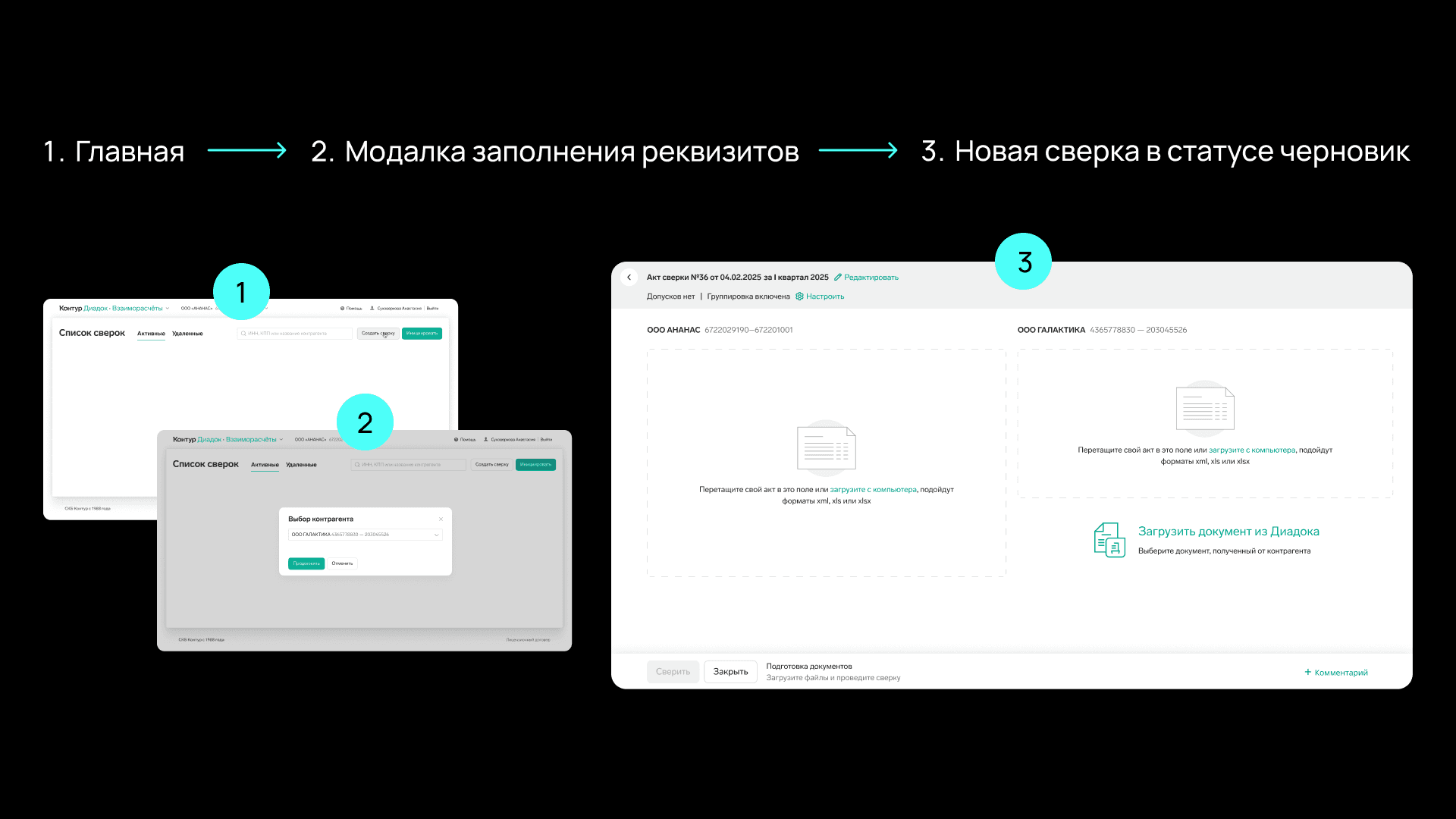
On the entry screen, the two workflows were clearly separated: Reconcile files and Initiate reconciliation with a partner

1 workflow = 1 task

2

Document fields redesign

  • Document fields were moved to the creation stage

  • Required fields were clearly defined

  • Reconciliation period logic was adapted to each workflow

  • Edits no longer require rerunning reconciliation

Clear and predictable sequence of steps

3

New state system

  • Added a Draft state for document preparation

  • Introduced intermediate saving

  • Statuses became transparent and logically structured

Saving Progress

Success metrics

1

User satisfaction

+5%

CSAT for the reconciliation task increased by 5%

The score was collected via a survey shown after completing any reconciliation task

2

Task complexity

Support requests decreased

Repeat reconciliations for the same period decreased

Outcome

The hypothesis was confirmed. Separating the workflows reduced cognitive complexity and improved user satisfaction without changing the core business logic of the service

Гипотеза подтверждена. Изменения сократили когнитивную сложность сценария и дали измеримый рост удовлетворённости пользователей без изменения бизнес-логики сервиса

Create a free website with Framer, the website builder loved by startups, designers and agencies.